
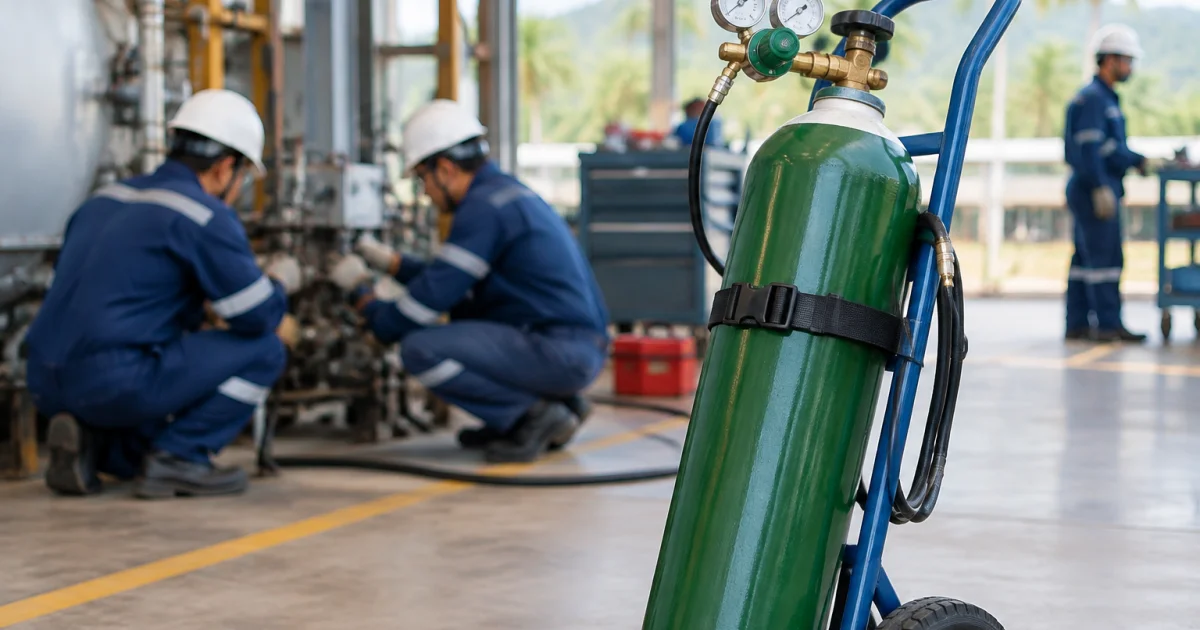
Portable Oxygen Cylinder Malaysia: Availability, Delivery Options, and Compliance for Site Work
For many Malaysian factories, maintenance teams, and industrial contractors, oxygen is a job-critical input for oxy-fuel cutting, heating, brazing support, and related workshop tasks. When the work is mobile—shutdowns, plant modifications, on-site fabrication, and emergency repairs—portability becomes the deciding factor. A portable cylinder must be available when needed, delivered in a way that fits your site constraints, and managed under a safety and compliance approach that prevents downtime.
This article supports commercial buyers evaluating Portable Oxygen Cylinder Malaysia supply: how to assess real availability, what delivery options matter for factory and project sites, and which compliance items to clarify before recurring orders. The focus is procurement and site-readiness—what to ask, what to check, and how to avoid common gaps that only show up after mobilization.
Why portable oxygen cylinders are still the go-to for site work
Bulk oxygen and piped systems fit stable, high-consumption operations. Many industrial environments, however, have variable demand: periodic cutting support, planned shutdowns, or contractors moving between job locations. In these cases, portable cylinders remain the simplest way to bring oxygen to the work while keeping capex and installation complexity low.
Portable cylinders are commonly used for:
- Oxy-fuel cutting for dismantling, plate cutting, and structural modifications (paired with a fuel gas such as acetylene).
- Hot-work support in temporary or confined areas where long hose runs from a stationary manifold are impractical.
- Maintenance and turnaround jobs where the workfront moves and consumption spikes for short periods.
- Emergency response when fast replacement keeps production or repairs moving.
Even if your day-to-day operations rely on other gases—argon gas for TIG shielding, CO for certain welding mixes, or nitrogen (often called N2 gas) for purging—oxygen becomes a bottleneck when oxy-cutting is in the method statement. Procurement often evaluates oxygen and fuel gas together, alongside regulators, flashback arrestors, hose sets, and cutting consumables.
Supply availability: what in stock should mean to industrial buyers
For industrial use, availability is more than a cylinder sitting in a store. It should reflect readiness: cylinder condition, delivery ability on your required dates, and continuity over the job duration.
1) Short-term availability vs. continuity of supply
For a one-off job, short-term supply may be enough. For multi-week work and recurring maintenance, continuity matters more:
- Allocation: how many cylinders can be reserved for your project period?
- Peak support: can the supplier support high-consumption days (e.g., shutdown week)?
- Replacement workflow: what is the process for same-day or next-day exchange?
The buyer goal is to reduce job-stop risk and avoid last-minute sourcing that can compromise safety and documentation.
2) Cylinder ownership model and exchange process
Many Malaysian industrial buyers use an exchange model: empties are swapped for filled cylinders. Clarify upfront:
- Exchange rules: like-for-like sizes and valve types, and any limits by depot/route.
- Traceability: whether cylinder movement can support your internal records and contractor controls.
- Project staging: whether filled cylinders can be staged before a shutdown, with batch exchanges after.
If you operate across multiple sites, confirm whether exchanges can be performed at different locations or must follow a fixed delivery route. These details directly affect logistics planning.
3) Purity and application fit (industrial vs. higher-purity needs)
For cutting and general hot-work, standard industrial oxygen is typically suitable. Some facilities require tighter specifications for controlled environments or sensitive production steps. If your work touches lab-adjacent areas, calibration tasks, or processes with stricter controls, ask about higher-purity options and how they are packaged and documented.
In mixed sites (factory + R&D + maintenance), it is common to carry both industrial supply and higher-purity supply for designated areas. Align the grade with process risk rather than assuming one specification fits all.
Choosing the right portable cylinder setup for cutting and site work
Buyers often focus on cylinder size and overlook the full system: regulator, connection standards, safety devices, and how cylinders are transported and secured on site. A cylinder that arrives but cannot be connected safely, or cannot be moved to the workfront, is not job-ready.
Core components to confirm in your quotation
- Cylinder size and format: define what portable means for your team (hand-movable vs. trolley-mounted).
- Regulator type: confirm compatibility with the valve and required flow/pressure for your torch.
- Hose set and fittings: verify correct hose type and whether twin hoses are needed for oxy-fuel work.
- Flashback arrestors and non-return valves: critical for oxy-fuel safety.
- Cutting torch and nozzles: ensure nozzle selection matches material thickness if equipment is supplied together.
Many sites also bundle consumables that affect day-to-day productivity: cutting tips, contact tips (for MIG), grinding/cutting discs, and a suitable cutting wheel. While separate from oxygen supply, coordinated sourcing reduces delays during shutdowns when small missing parts can halt work.
Practical example: shutdown cutting team on a moving workfront
For a contractor supporting a plant shutdown with multiple cutting stations, a workable setup often includes:
- Central staging in a designated, ventilated, secured area with clear signage.
- Trolley deployment to each workfront, with cylinders upright and restrained.
- Daily issue-and-return for regulators and torches to control damage and maintain records.
- Planned exchanges at predictable times (e.g., end of shift) to avoid mid-task interruptions.
This translates into supplier requirements: consistent exchange timing, sufficient quantity, and delivery coordination that prevents bottlenecks.
Delivery options in Malaysia that affect downtime (and how to compare them)
Delivery is not only a transport fee; it is a reliability feature. Evaluate it like lead time for critical spares: based on access, safety controls, and the operational cost of delays.
1) Scheduled route delivery vs. on-demand delivery
Most buyers benefit from a scheduled delivery rhythm (e.g., weekly replenishment) to keep stock stable. On-demand delivery becomes important when:
- Ramping up for shutdowns or project starts.
- Unplanned cutting work appears due to breakdowns or urgent modifications.
- Multiple crews increase consumption beyond forecast.
Ask how urgent requests are handled: required information, cut-off times, and whether the supplier can support your coverage area (Penang and Northern Malaysia are often key for regional factories).
2) Site access requirements and delivery constraints
Factory controls can delay deliveries if not planned:
- Security procedures and driver registration.
- Delivery windows (e.g., restricted times during shift change).
- Unloading points and internal movement responsibilities (who moves cylinders to storage?).
- PPE and safety briefing requirements for external drivers/attendants.
A practical step is to share a one-page delivery instruction sheet with shortlisted suppliers to reduce gate delays and make performance easier to measure.
3) Pallet-type supply solutions vs. true portable
Higher-consumption sites may use pallet-type supply to reduce handling and improve stability of supply (including nitrogen pallet arrangements for some operations). However, it does not replace portable oxygen where workfronts move, access is tight, or teams operate across spread-out areas.
Many facilities use a hybrid approach:
- Pallet or manifold arrangements for workshop zones with repeatable work.
- Portable cylinders for mobile teams, contractors, and remote job areas.
When comparing quotations, ask suppliers to recommend a layout based on your consumption pattern rather than repeating last years setup by default.
Compliance and safety considerations buyers should clarify before ordering
Portable oxygen becomes high-risk if mishandled. Compliance is not only regulatory; it is operational. Safety incidents, failed audits, or incomplete documentation can stop work. Buyers should ensure supply matches the site safety management system and that cylinders and accessories arrive fit for industrial use.
1) Documentation you should request
Ensure you can obtain the required safety documentation (commonly SDS) for the gases used. Many sites run a controlled SDS register, and contractors may need to submit SDS to clients before mobilization.
Also align internal controls such as:
- Receiving checks (visual condition, valve protection, leak-check practice).
- Storage and segregation guidance for oxygen vs. fuel gases such as acetylene.
- Hot-work permit alignment with your permit-to-work and JSA requirements.
For a broader overview of typical controls, you may review industrial gas safety standards in Malaysia before finalizing procurement requirements.
2) Handling, transport, and on-site movement controls
Many day-to-day risks occur during cylinder movement rather than during cutting. Common controls include:
- Transport cylinders upright and secured (trolley/restraint) to prevent falling.
- Keep valve protection in place when cylinders are not connected.
- Prevent oil/grease contamination on oxygen equipment (regulators, fittings, gloves).
- Use correct hoses and backflow prevention devices for oxy-fuel systems.
- Train users on correct valve opening and isolation when not in use.
Procurement should confirm whether the supplier can support both gas delivery and compatible accessories (regulators, torch sets, hoses, and safety items). A one-stop approach reduces the risk of mixing incompatible parts across vendors.
3) Segregation from fuel gases (acetylene) and compatibility checks
Portable oxygen is commonly paired with acetylene for oxy-acetylene cutting, so procurement and storage planning should be coordinated. Ask suppliers to confirm:
- Compatible regulator and hose specifications for both oxygen and acetylene.
- Recommended safety devices for your torch configuration.
- Practical storage guidance to separate oxygen from flammable gas cylinders.
Even if you are buying oxygen only today, many cutting operations require matched fuel gas availability; aligning both supplies helps avoid one gas becoming the bottleneck.
How to evaluate suppliers: questions that reduce risk and total cost
The goal is a shortlist you can award with confidence because operational details were verified before commitment. These questions help separate suppliers who can sell a cylinder from those who can support your site.
Commercial and operational capability
- Lead time for cylinder exchange and new allocations.
- Urgent replenishment process during shutdowns or unplanned maintenance.
- Delivery coverage (e.g., Penang and Northern Malaysia) and typical delivery windows.
- Multi-site support for contractors with multiple delivery points.
Safety, documentation, and support
- SDS availability and any supporting documentation required by your EHS system.
- Complete oxy-fuel setup supply (compatible regulators, hoses, flashback arrestors).
- Storage and handling advice for oxygen and acetylene on site.
Bundling and procurement efficiency
If you are also buying welding and cutting equipment, ask whether the supplier can support the full list: welding machines, torches, regulators, rods, MIG/TIG accessories, and workshop consumables. Delays often come from missing small items (a fitting, a hose, a cutting disc), not from the cylinder itself.
For teams running TIG and MIG, standardizing an approved shielding gas plan (argon gas for TIG; argon/CO mixes for some MIG applications) can reduce on-site improvisation. If helpful, see MIG vs TIG welding and choosing the right shielding gas.
Planning your cylinder inventory: simple methods that prevent mid-job shortages
Portable gas shortages are often caused by forecasting and on-site control issues rather than a complete lack of market supply. A simple inventory method can prevent emergency sourcing, especially when multiple crews share cylinders.
Step 1: Identify your peak usage scenario
Define the peak scenario you must support without disruptionfor example, two cutting teams running simultaneously for a full shift during shutdown week. Peak usage determines how many filled cylinders must be available at the start of the day.
Step 2: Set a reorder trigger and an exchange rhythm
Many sites use a trigger-based rule:
- Minimum on hand: the lowest number of filled cylinders allowed in store.
- Exchange trigger: the level that prompts scheduling exchange before you hit minimum.
- Buffer: extra cylinders to cover delivery delays and unexpected spikes.
As you track usage, refine the minimum and buffer levels, but even a basic trigger reduces mid-job shortages.
Step 3: Control the last mile to the workfront
Disruptions often happen after cylinders arrive: teams cannot locate filled cylinders, cylinders move without records, or regulators go missing. During shutdowns, issuing cylinders and key accessories through a storekeeper or appointed custodian improves traceability and reduces loss/damage. For broader portable cylinder context across gases (oxygen, nitrogen, argon, CO), see portable gas cylinders in Malaysia.
Common mistakes to avoid when buying portable oxygen cylinders
These recurring issues typically cost nothing to avoidthey require clearer confirmation upfront.
1) Buying oxygen only without confirming the complete cutting system
For cutting, the oxygen cylinder is only part of the system. Confirm regulators, hoses, torch type, and safety devices are compatible and available. If acetylene is part of the job, align deliveries and storage controls so one gas does not stall the work.
2) Not aligning delivery timing to site constraints
Many factories have strict delivery windows. If access rules are not shared early, deliveries may be delayed at the gate or turned away. Provide delivery instructions and plan exchanges at predictable times.
3) Underestimating handling needs
Portable still requires safe movement. Ensure enough cylinder trolleys, restraints, and a defined staging area. Avoid rolling cylinders or moving them unsecured to reduce safety risk and equipment damage.
4) Treating documentation as an afterthought
If clients require SDS submission or contractor documentation, work may not begin until paperwork is complete. Request SDS and supporting documents during quotation so they can be integrated into your EHS workflow before mobilization.
5) Splitting procurement across too many vendors
Buying cylinders from one supplier, regulators from another, and consumables elsewhere can work until compatibility or availability issues surface. Many buyers prefer a one-stop supplier for gases, cylinder solutions, and essential welding/cutting equipment to reduce coordination overhead.
Conclusion: what to confirm before you place your next order
Choosing a portable oxygen supply is not just about unit availability. For factories and contractors, the decision should be based on whether the supplier can reliably support your work pattern: consistent exchange, delivery that fits site constraints, and a compliance-ready package of documentation and safe-use support.
Before awarding supply, confirm four essentials: (1) continuity of cylinder availability during peak periods, (2) delivery rhythm and urgent replenishment capability, (3) correct and compatible cutting setup components, and (4) safety documentation and practical handling guidance that fits your permit-to-work and storage rules. When these are clear, portable oxygen becomes a predictable input rather than a shutdown risk.
To explore cylinder options and related industrial gas products, you can also review Wellgas cylinder product category for a structured view of gas cylinder solutions.
Frequently Asked Questions
How do I know if a portable oxygen cylinder supply is truly available for my project timeline?
Treat “available” as continuity, not just a single cylinder in stock. Ask the supplier how many cylinders can be allocated for your project period, how exchanges are handled during peak days (e.g., shutdown week), and what their urgent replenishment process looks like if consumption exceeds forecast.
What delivery details should factories in Malaysia confirm before scheduling oxygen cylinder drops?
Confirm site access rules (security registration, delivery time windows, unloading points), who is responsible for moving cylinders from the loading bay to the storage area, and whether your site requires PPE or briefings for external delivery personnel. Sharing a one-page delivery instruction sheet early helps prevent gate delays.
Can portable oxygen be used together with acetylene for oxy-fuel cutting?
Yes—portable oxygen is commonly paired with acetylene for oxy-acetylene cutting. The key is to ensure correct regulators for each gas, compatible hose sets and torch equipment, and appropriate safety devices such as flashback arrestors/non-return valves. Also plan safe storage segregation between oxygen and fuel gas cylinders.
What is argon gas used for, and how is it different from oxygen on site?
Argon gas is typically used as a shielding gas for welding (especially TIG) to protect the weld pool from atmospheric contamination. Oxygen, by contrast, is commonly used as an oxidizer in oxy-fuel cutting and heating applications. Many sites use both, but they serve different processes and require different setups and controls.
What basic compliance documents should I request when buying industrial gases for site work?
Request the Safety Data Sheet (SDS) for each gas you will use (oxygen, acetylene, argon, nitrogen, CO2, etc.) so it can be registered in your EHS system and submitted to clients if required. Internally, maintain receiving checks, storage/segregation guidance, and alignment with hot-work permit-to-work procedures.
Need a reliable portable oxygen cylinder supply for your factory or site team?
Wellgas SDN. BHD. supports factories, fabrication shops, and contractors with industrial gas supply, portable cylinder solutions, and the related welding/cutting equipment and safety products needed to keep site work moving. Share your location, usage pattern, and delivery constraints, and we’ll help you plan a practical supply and exchange approach.
Disclaimer
We hope you find this article helpful and informative. The content provided is for general informational purposes only and does not constitute professional advice or necessarily reflect the full range of services offered by Wellgas Sdn. Bhd.
For personalized guidance, please consult a professional or contact us directly. While we strive for accuracy and completeness, we cannot guarantee that the information is error-free. Wellgas Sdn. Bhd. assumes no responsibility for any errors or omissions.