
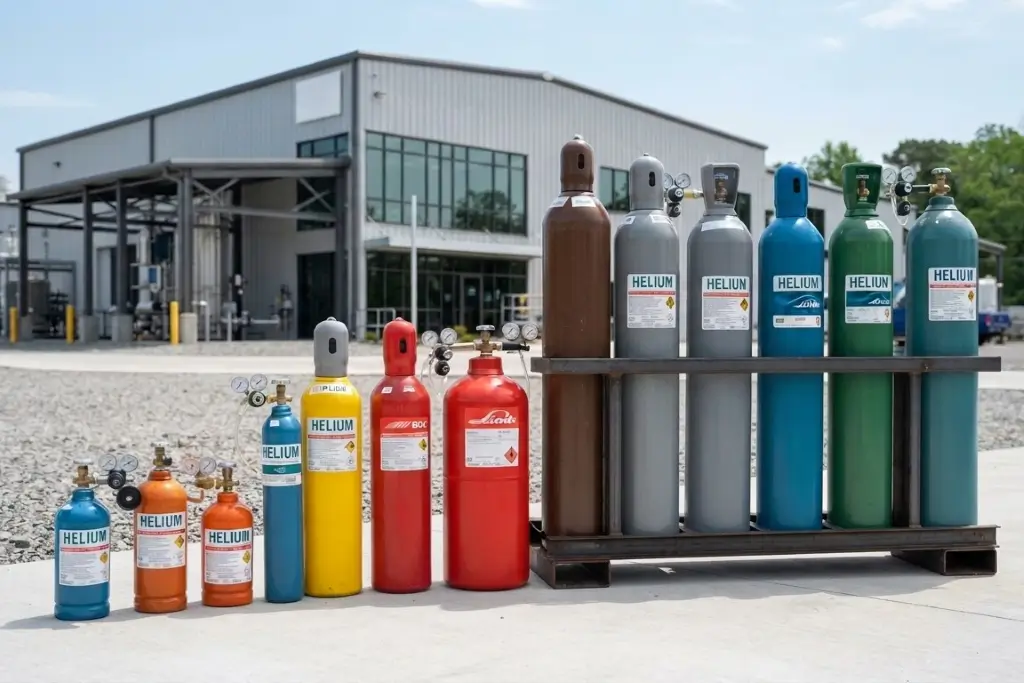
Helium Gas Buying Guide: Purity, Uses & Industry Applications
When most people think of helium, they picture floating balloons at celebrations. However, helium gas Malaysia serves a far greater purpose than entertainment. It is a critical industrial gas supporting Malaysia’s semiconductor manufacturing, healthcare, scientific research, metal fabrication, and commercial event industries.
From cooling superconducting magnets inside MRI systems to providing ultra-clean carrier gas for laboratory analysis and shielding welds during precision manufacturing, helium has become indispensable across numerous sectors.
Unlike many industrial gases, helium is a finite natural resource that cannot be artificially manufactured in commercial quantities. Global production depends on a limited number of natural gas fields, making supply vulnerable to geopolitical issues, maintenance shutdowns, and transportation disruptions.
These global fluctuations have periodically caused helium shortages and price volatility, making procurement more challenging for Malaysian businesses. Rather than relying solely on spot purchases, companies increasingly need dependable local suppliers capable of maintaining consistent inventory and efficient distribution.
Understanding Helium Grades: Balloon vs. Industrial Helium
Not all helium is created equal. One of the most common purchasing mistakes is assuming every helium cylinder contains identical gas. In reality, helium is available in different purity grades designed for specific applications.
Selecting the wrong grade can unnecessarily increase operating costs or even compromise laboratory accuracy and manufacturing quality.
Before purchasing helium, businesses should first determine the purity level required for their intended application.
Technical Comparison Table
| Specification | Balloon Grade Helium (Grade 4.0) | Industrial Grade Helium (Grade 4.5) | Laboratory Grade Helium (Grade 5.0+) |
|---|---|---|---|
| Purity | Approximately 99.99% | Approximately 99.995% | 99.999% or higher |
| Primary Applications | Balloon inflation, events, advertising displays | TIG/MIG welding, leak detection, industrial manufacturing | Gas chromatography, analytical laboratories, research, MRI systems |
| Typical Industries | Event management, retail, entertainment | Manufacturing, engineering, automotive | Medical, pharmaceutical, semiconductor, research institutions |
| Performance Requirement | Buoyancy | Stable shielding and testing | Extremely low contamination |
| Cost | Most economical | Moderate | Premium |
Balloon Grade Helium (Grade 4.0)
Balloon-grade helium typically offers approximately 99.99% purity, making it ideal for buoyancy applications. It is widely used for:
- Corporate events
- Product launches
- Shopping mall decorations
- Weddings
- Promotional campaigns
- Retail balloon businesses
For these applications, ultra-high purity provides little additional value because the primary objective is lifting balloons efficiently and safely.
Businesses searching for balloon gas Malaysia generally require this grade due to its cost-effectiveness and practical suitability.
Industrial & Laboratory Helium (Grade 4.5–5.0+)
Industrial operations demand significantly higher purity.
Grades 4.5 (99.995%) and 5.0 (99.999%) are commonly used in:
- Gas chromatography (GC)
- Leak detection systems
- Semiconductor manufacturing
- Precision TIG and MIG welding
- MRI superconducting magnet cooling
- Scientific laboratories
- Pharmaceutical production
These applications depend on exceptionally low contamination levels because even trace impurities can influence analytical results, weaken weld integrity, or reduce equipment performance. For more detail may refer, Helium Gas for Balloons vs. Industrial Use: What’s the Difference?
For example, laboratories performing gas chromatography require highly stable carrier gases to ensure accurate analytical measurements. Similarly, precision welding operations rely on clean shielding gas to minimise oxidation and produce defect-free welds.
Using balloon-grade helium for these industrial processes may introduce contaminants that compromise product quality, damage sensitive equipment, or cause failed quality inspections. Conversely, purchasing laboratory-grade helium solely for balloon inflation unnecessarily increases operational costs without delivering additional benefits.
Choosing the correct helium grade is therefore an important balance between technical requirements and cost efficiency.
Key Safety Standards for Industrial Gases in Malaysia
Despite helium’s widespread use, misconceptions continue to influence purchasing and safety decisions.
Myth: Helium is highly flammable and explosive.
Fact: Helium is a noble gas that is completely inert, non-reactive, and non-flammable. Unlike hydrogen, helium does not burn, explode, or support combustion. This makes it one of the safest industrial gases when handled correctly.
Myth: Global helium shortages mean businesses cannot obtain helium in Malaysia.
Fact: While worldwide helium supply has experienced periodic disruptions due to production and logistics constraints, reliable Malaysian suppliers with established international sourcing networks continue to support industrial customers through effective inventory planning and distribution.
Myth: Inhaling helium from a cylinder is a harmless party trick.
Fact: This misconception can be extremely dangerous. Pure helium rapidly displaces oxygen inside the lungs. Without sufficient oxygen, the brain can become deprived within seconds, potentially resulting in unconsciousness, permanent injury, or death. High-pressure cylinders also present additional physical hazards if misused.
Industrial helium should only be used for its intended applications and never inhaled under any circumstances.
Safety Protocols & Workplace Compliance in Malaysia
Although helium is non-flammable, it remains a high-pressure compressed gas that requires proper storage, transportation, and handling. Malaysian workplaces should follow guidance provided under the Department of Occupational Safety and Health (DOSH) and applicable occupational safety regulations governing compressed gas cylinders.
Proper safety procedures reduce the risk of physical injuries, accidental gas release, and oxygen-deficient environments.
Safe High-Pressure Cylinder Handling Workflow
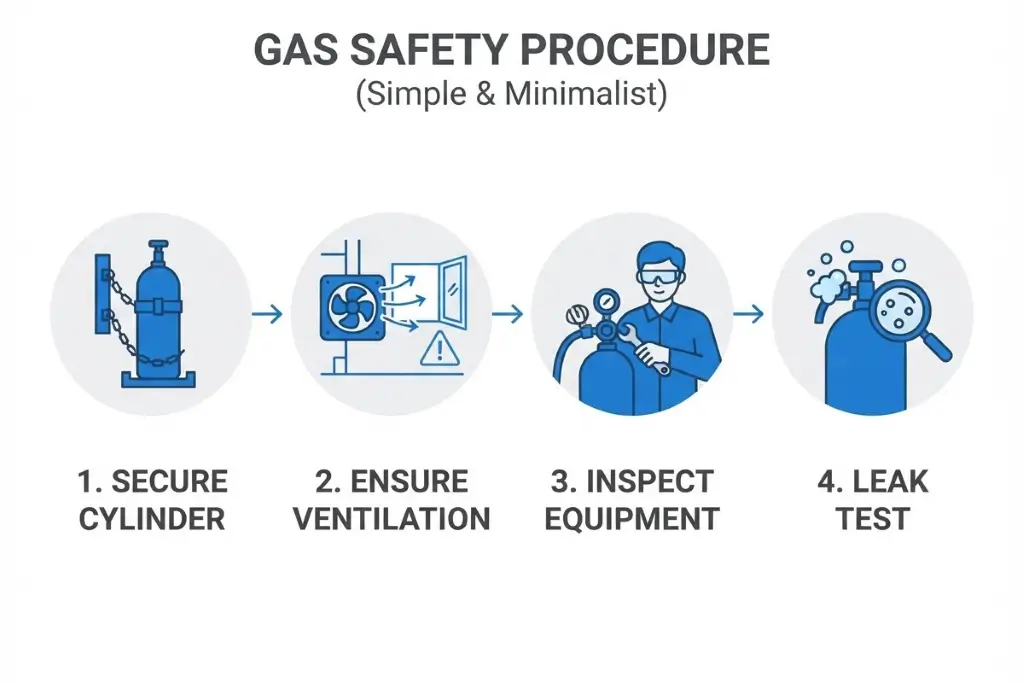
Step 1: Secure the Cylinder
Always store cylinders upright using approved cylinder racks, chains, or restraints. Never leave cylinders unsecured where they may fall and damage the valve assembly.
Step 2: Maintain Adequate Ventilation
Helium is colourless, odourless, and lighter than air. Although non-toxic, it displaces oxygen in enclosed spaces. Storage rooms and work areas should always be well ventilated to prevent oxygen-deficient atmospheres.
Step 3: Inspect Before Operation
Before connecting regulators or equipment:
- Check the cylinder label
- Inspect valves for damage
- Confirm regulator compatibility
- Examine hoses and fittings for wear
Any damaged cylinder should be isolated and reported immediately.
Step 4: Perform Leak Testing
After connecting the system, conduct leak testing using approved leak detection methods before beginning operations. Never attempt to detect leaks using open flames.
Additional Best Practices
Businesses should also implement several operational controls:
- Train authorised personnel on compressed gas handling procedures.
- Separate full and empty cylinders for easier inventory management.
- Protect cylinders from excessive heat and direct sunlight.
- Transport cylinders using dedicated cylinder trolleys rather than dragging or rolling them.
- Keep protective valve caps installed whenever cylinders are not connected.
Routine inspections, preventive maintenance, and employee training contribute significantly to safer workplaces while supporting compliance with Malaysian occupational safety requirements.
Choosing a Reliable Helium Gas Supplier in Malaysia
Selecting a helium supplier involves more than comparing prices. Procurement teams should evaluate whether the supplier can consistently deliver the correct gas grade, maintain stable inventory, and provide responsive technical support when operational demands arise.
A dependable supplier should offer:
- Multiple helium purity grades for different industries
- Consistent stock availability
- Reliable nationwide delivery
- Proper cylinder management and exchange programmes
- Technical guidance on gas selection and safe handling
- Compliance with Malaysian safety standards
Working with an experienced local supplier also helps businesses minimise downtime caused by unexpected supply disruptions while ensuring the helium supplied matches operational requirements.
Conclusion
Helium is far more than a balloon gas. It is an essential industrial resource supporting Malaysia’s healthcare, manufacturing, semiconductor, laboratory, engineering, and commercial event industries.
Choosing the appropriate helium grade, understanding common misconceptions, following safe handling practices, and partnering with a dependable supplier are all critical factors for maintaining operational efficiency and workplace safety.
Whether your business requires balloon-grade helium for promotional events or ultra-high-purity helium for laboratory analysis, selecting the right supplier ensures consistent quality, regulatory compliance, and uninterrupted operations.
Need help choosing the right helium gas solution for your business? Contact our team for expert guidance on selecting the appropriate helium grade for your application. You can also explore our website to discover our complete range of industrial gas products, technical resources, and solutions designed to support your operational needs.
Disclaimer
We hope you find this article helpful and informative. The content provided is for general informational purposes only and does not constitute professional advice or necessarily reflect the full range of services offered by Wellgas Sdn. Bhd.
For personalized guidance, please consult a professional or contact us directly. While we strive for accuracy and completeness, we cannot guarantee that the information is error-free. Wellgas Sdn. Bhd. assumes no responsibility for any errors or omissions.