
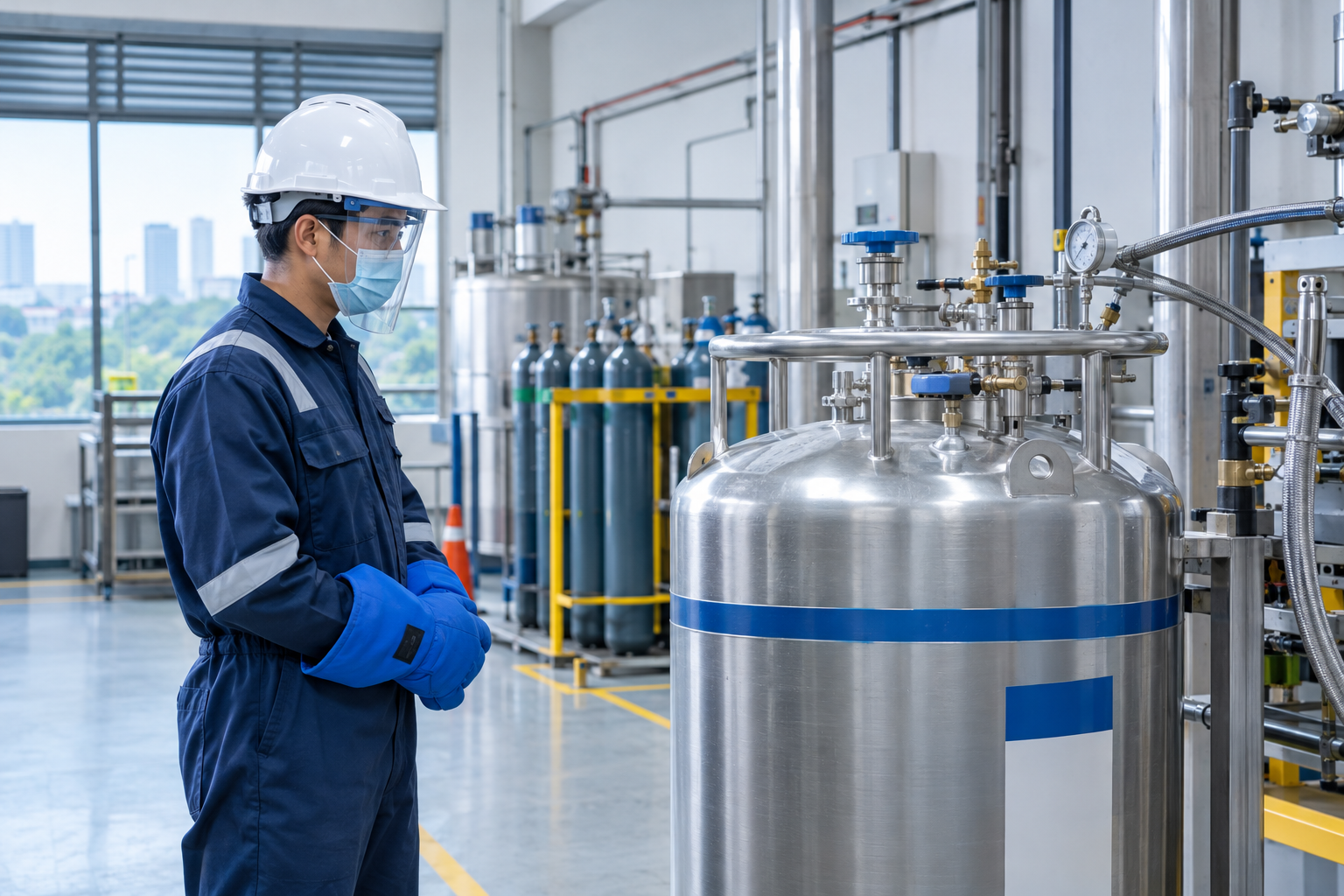
Small-volume Liquid Nitrogen in Malaysia: Buy, Store and Use Safely for Workshops and Labs
Small-volume Liquid Nitrogen in Malaysia: Buy, Store and Use Safely for Workshops and Labs
Small-volume liquid nitrogen can suit a Malaysian laboratory, workshop or engineering team, but the right purchase depends on more than the liquid quantity. Before ordering, match the application and consumption rate to a compatible Dewar or portable liquid container, confirm the delivery or refill method, and check that the storage area can manage oxygen displacement and pressure hazards.
Start with a written enquiry covering the intended use, estimated consumption, required purity, container type, delivery location, refill expectations and safety documentation. For an initial reference point, review the Liquid Nitrogen Malaysia supply options, then confirm the actual container and delivery arrangement directly with the supplier.
Before you buy: define the job and the quantity
“Small volume” is not a universal vessel size. A laboratory that uses liquid nitrogen intermittently may need a portable liquid nitrogen tank or liquid nitrogen Dewar tank. A process that requires regular topping up may need a refill arrangement or a larger cryogenic system. The practical choice depends on consumption rate, opening frequency, mobility, available storage space and how disruptive an interruption would be.
Write down these details before requesting a quotation:
- What the liquid nitrogen will do, such as laboratory work, cooling, testing or another defined process.
- Expected consumption per day, week or month, including occasional peak demand.
- Whether the container must remain mobile or can stay in a designated storage area.
- How often personnel will access it and who is trained to handle cryogenic liquids.
- Whether delivery, collection, on-site refill or scheduled refill is most practical.
- Whether the application needs a stated purity or consistency level.
These inputs allow a supplier to distinguish a portable container from a refill-supported arrangement. They also prevent a common buying mistake: selecting a vessel because it is available rather than because it matches the work, transfer method and site controls.
How to buy small-volume liquid nitrogen in Malaysia
Ask for a written quotation that identifies the liquid nitrogen quantity, purity or grade where relevant, container arrangement and all recurring charges. Compare quotations only when the same assumptions are applied to every supplier.
Match the supply arrangement to how the nitrogen will be used. Intermittent laboratory use may suit a portable liquid-nitrogen tank or Dewar, while regular topping-up may require a refill arrangement or a larger cryogenic system. Base the choice on consumption rate, opening frequency, mobility, available storage space and the consequences of an interruption. Confirm the compatible container, delivery area and refill terms with the supplier before ordering.
| Operating condition | Likely discussion point | What to confirm next |
|---|---|---|
| Occasional use with low demand | Portable liquid nitrogen tank or Dewar | Container compatibility, static hold time, refill or collection process |
| Regular use with a mobile requirement | Portable container with planned refills | Delivery frequency, access requirements and who manages the container |
| Continuous or high-demand process | Larger cryogenic storage arrangement | Footprint, access, pressure relief, ventilation and specialist design requirements |
Do not treat these as fixed capacity categories. The supplier must confirm the suitable vessel and operating arrangement for the actual application. Some supply listings describe portable liquid nitrogen tanks, Dewar tanks and on-site refilling, but availability, equipment compatibility and delivery terms vary by location and order size.
Compare quotations using the full cost rather than only the liquid price. Request separate line items for the quantity or unit price, minimum order, delivery charge, container rental or deposit, refill frequency, collection requirements and any equipment or service charges. Ask whether the quotation assumes a particular container, static holding period or delivery access condition. There is no verified Malaysian price list in this guide, so a transparent breakdown is more useful than an unsupported price estimate.
For a deeper procurement comparison involving cylinders, pallet packs and bulk arrangements, see this guide to industrial gas procurement in Malaysia. Liquid nitrogen supply needs its own cryogenic container and safety checks; a standard compressed-gas cylinder arrangement is not automatically interchangeable.
Safe storage: vessel, ventilation and pressure relief
Store liquid nitrogen only in equipment designed for cryogenic liquid service. A Dewar, portable liquid container or laboratory tank is not simply an ordinary container with insulation. Confirm that the vessel is compatible with liquid nitrogen, the intended transfer method and the required pressure-management arrangement.
Supplier descriptions may present a liquid-nitrogen tank as a high-performance, liquid-phase storage container for laboratory use, including central laboratories. Treat those labels as a starting point rather than proof that the vessel suits your operation. Ask which model is proposed, whether it is intended for storage or dispensing, how it is transferred, and which pressure-relief and handling instructions apply. Confirm compatibility with your actual laboratory or workshop process before ordering. Where a Dewar is the preferred arrangement, compare the supplier’s Dewar tank options with the required access, mobility and refill method.
Warming liquid nitrogen produces gas. A cryogenic storage system therefore needs suitable pressure relief and must not be sealed or improvised. A supply-tank description may explain that controlled vaporisation can generate pressure to discharge liquid to another container; that does not mean a user should create pressure manually or modify the equipment. Follow the relevant equipment instructions and supplier guidance.
Ventilation is equally important. Liquid nitrogen can rapidly become gas and displace breathable oxygen. The USDA describes expansion of roughly 694–696 times and warns that oxygen displacement may cause dizziness, unconsciousness or death without warning; read the liquid nitrogen safety guidance. A relatively small spill can affect air conditions, particularly in an enclosed or poorly ventilated space.
Before delivery, identify the storage location, ventilation path, access route and emergency procedure. A site-specific assessment may require oxygen monitoring or other controls, depending on the quantity, room conditions and work pattern. Do not assume that opening a door or using a general workshop fan is an adequate control without competent review.
Use liquid nitrogen safely: a practical work sequence
Only trained personnel should receive, transfer or use liquid nitrogen. The work procedure should cover the container inspection, transfer equipment, personal protective equipment, ventilation, spill response and stop conditions.
Receiving and transferring the liquid
- Confirm the delivery matches the order and that the vessel is intended for liquid nitrogen before accepting it.
- Inspect the container, fittings, labels and pressure-relief features. Stop if the equipment is damaged, unsuitable or modified.
- Move the container using the method specified for that equipment. Avoid improvised lifting or transport arrangements.
- Use suitable cryogenic gloves and face or eye protection selected for the task. Gloves alone do not control oxygen-deficiency or pressure hazards.
- Follow the approved transfer procedure and keep people away from splashing or uncontrolled discharge.
- Return the container to its designated ventilated location and keep access clear.
Liquid nitrogen and cold vapour can cause cold burns, frostbite and serious eye injury. The University of Iowa also warns that vaporisation can reduce oxygen below 19.5% and create an asphyxiation hazard; its liquid nitrogen handling guidance explains these injury and atmosphere risks.
Liquid nitrogen expands by approximately 696:1 when it vaporises, so even small-volume handling can create an oxygen-deficiency hazard. Treat oxygen below 19.5% as an emergency condition: ventilation and an oxygen-deficiency response plan address the surrounding air, while cryogenic gloves and face or eye protection address cold contact. These controls serve different purposes and should not be treated as interchangeable.
Stop work and follow the site emergency procedure if there is a spill, rising vapour, an alarm, poor ventilation, a damaged vessel or uncertainty about the transfer. Do not enter a suspected oxygen-deficient area to investigate. Escalate to the responsible safety lead or a qualified professional.
Decision checklist and supplier enquiry
Order only after the application, quantity, vessel, delivery method, SDS, ventilation and pressure-relief requirements have been confirmed. Pause for a competent risk assessment when the storage area is enclosed, the process requires fixed piping, the quantity is increasing, oxygen monitoring may be needed or staff are not trained.
Send suppliers a concise enquiry containing:
- Application and estimated consumption rate.
- Required purity or consistency, if relevant.
- Preferred portable container, Dewar or other storage arrangement.
- Delivery location and access limitations in Malaysia.
- Expected refill frequency and whether collection or on-site refill is available.
- Ask the supplier or consult the container manual to verify compatibility with liquid nitrogen, pressure-relief arrangements and any stated holding assumptions; these details depend on the proposed vessel and operating conditions.
- SDS, handling requirements and recommended training or PPE information.
- Separate liquid, delivery, rental, deposit and service charges.
Wellgas provides industrial gas and cryogenic product information for Malaysian buyers, but stock, delivery coverage and suitability still need to be confirmed for your site. Contact the supplier with the enquiry details above rather than requesting only a price.
Frequently Asked Questions
Where can you purchase liquid nitrogen in Malaysia?
Contact an industrial-gas supplier and ask about current availability, purity, quantity, compatible Dewar or portable liquid container, delivery area and refill arrangements. Confirm these details directly because supply and delivery terms vary by location, order size and container requirements.
Is liquid nitrogen safe to use in an indoor workshop or laboratory?
It can be used only when the site has suitable equipment, trained personnel, ventilation and a task-specific risk assessment. Liquid nitrogen can cause cryogenic injury and can displace oxygen as it vaporises, so an indoor location should not be treated as safe merely because the quantity is small.
How should I choose between a Dewar refill and a larger tank?
Choose the arrangement by comparing consumption, mobility, available footprint, refill frequency and tolerance for interruption. A Dewar or portable container may suit intermittent or mobile work, while sustained demand may justify a larger system, subject to supplier confirmation, site design and pressure-relief requirements.
How long will liquid nitrogen last in a Dewar?
Holding time depends on the specific Dewar, insulation, condition, ambient environment and how frequently it is opened. Ask the supplier for the stated static holding time or evaporation rate for the exact vessel, and never seal liquid nitrogen in an ordinary airtight container.