
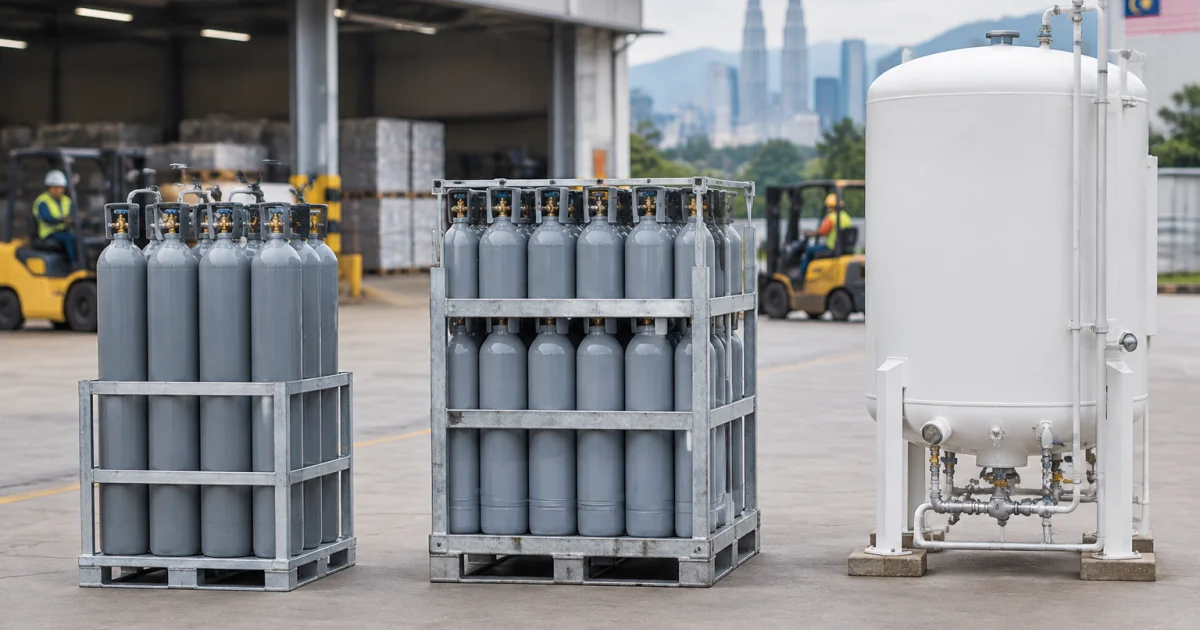
Industrial Gas Malaysia Procurement: Choosing Cylinders, Pallet Packs, or Bulk Supply
Industrial gases are essential utilities in manufacturing. They influence weld quality, purge reliability, cutting performance, product consistency, and uptime. Procurement should look beyond “cheapest per cylinder” and choose a supply mode that protects operations with acceptable risk, labor, and site requirements.
This guide helps procurement teams and plant engineers managing Industrial Gas Malaysia sourcing for welding, maintenance, glove/plastics, food processing, and labs. We compare three supply modes—individual cylinders, pallet-type cylinder packs (bundles), and bulk storage (including cryogenic liquids where applicable)—and show how to select based on consumption, downtime tolerance, and site constraints.
Start with the decision drivers: usage, uptime, and site constraints
Align procurement, production, and EHS on what “reliable supply” means for your site. The right mode typically depends on:
- Consumption profile: average usage, peak demand by shift, and variability (steady vs batch).
- Criticality and uptime tolerance: how long can the process pause before scrap, quality risk, or schedule loss?
- Gas type and purity: standard vs purified/specialty needs; contamination sensitivity.
- Changeover and handling burden: time spent swapping cylinders, moving bottles, and managing regulators/manifolds.
- Footprint and access: storage area, forklift access, delivery route, and segregation requirements.
- Safety and training capability: readiness for higher inventories, manifolds, and (for bulk) cryogenic hazards.
- Total cost of ownership (TCO): gas price plus labor, rentals/assets, losses, and disruption risk.
Unit price alone can mislead: frequent changeovers, unstable flow, or run-outs often cost more than invoice savings.
Option 1: Individual cylinders (most flexible, highest handling)
Individual cylinders need minimal infrastructure and are easy to deploy. They suit multiple points of use—welding bays, maintenance work, and mobile teams—where flexibility matters more than continuous central supply.
Where cylinders fit best
- Low to moderate consumption or intermittent demand (maintenance, rework, seasonal work).
- Many points of use where mobility is needed.
- Multiple gas types in smaller quantities (argon gas, oxygen, acetylene gas, CO2).
- Limited capex or space for a central gas yard.
Operational trade-offs to price into your decision
- Changeover frequency: labor and disruption, especially during critical weld sequences.
- Pressure/flow consistency: stable delivery can be harder as cylinders empty, particularly at higher draw.
- Inventory complexity: more SKUs and higher risk of the wrong cylinder at the station.
- Handling and safety exposure: more movement increases risk (valve damage, tip-over, poor segregation of oxidisers and flammables).
Practical tip: Standardise cylinder sizes per department, assign clear storage locations, and set reorder triggers (e.g., minimum full cylinders per gas type per shift). In high-use areas, a small manifolded bank can improve continuity while keeping cylinders for mobile work.
Option 2: Pallet-type cylinder packs (bundles) for higher uptime with moderate footprint
Pallet-type packs group multiple cylinders in a palletised frame supplied through a manifold. For many manufacturers, they reduce changeovers and improve planning without the footprint and infrastructure of bulk tanks.
When pallet packs make the most sense
- Medium to high consumption where cylinder swapping is hurting productivity.
- Uptime-sensitive operations (steady shielding gas, continuous purge/inerting, tight fabrication schedules).
- Sites with forklift access and a defined outdoor/ventilated storage zone.
- Common gases like nitrogen and argon used in meaningful volumes.
Advantages procurement should quantify
- Fewer changeovers and deliveries: less operator time and fewer “unexpected empty” events.
- More stable supply: easier pressure/flow control from a consistent manifolded source.
- Better organisation: designated bundle locations reduce scattered cylinders and improve housekeeping.
Constraints and common pitfalls
- Space and segregation: adequate footprint and compliant separation from ignition sources/incompatible materials.
- Distribution to point-of-use: may require piping/hoses, correct regulators, flashback arrestors (where relevant), and protected routing.
- Peak draw limits: high-flow demands can exceed bundle capability without proper sizing and pressure management.
Procurement checkpoint: Confirm with engineering the required maximum flow and minimum pressure at point-of-use, then validate the bundle configuration and regulator/manifold setup can meet those conditions.
If pallet packs are on your shortlist, review Wellgas SDN. BHD.’s pallet-type gas supply options to see typical configurations and use cases.
Option 3: Bulk supply (highest continuity, highest planning and site requirements)
Bulk supply—typically a storage tank with vaporiser systems for cryogenic liquid gases (such as liquid nitrogen) or large centralised systems—delivers strong continuity with minimal routine handling. It is usually chosen when consumption is high, downtime tolerance is low, and the site can support the footprint, access, and safety controls.
Best-fit scenarios for bulk
- High-volume, stable demand: predictable usage (continuous nitrogen inerting, high-throughput processes, repeat fabrication workloads).
- High cost of interruption: where a line stop or quality incident outweighs added infrastructure cost.
- Centralised distribution: multiple departments supplied via a controlled reticulation network.
What changes with bulk (beyond the tank)
- Site engineering: foundation, clearances, impact protection, and vehicle access.
- Process governance: operating procedures, emergency readiness, trained personnel.
- Monitoring: level/pressure monitoring, alarms, reorder points aligned to delivery lead time.
- Contracting model: service levels for delivery, response time, and contingency options.
Practical explanation: Bulk value often comes from workflow and reliability—fewer manual interventions, fewer handling near-misses, fewer unplanned stops, and more consistent delivery—not only a lower nominal gas price.
Match supply mode to your application: welding, cutting, purging, and process gas
Selection becomes clearer when you map supply modes to process needs. Below are common patterns in Malaysian manufacturing.
Welding and fabrication (argon, CO2, mixed gas solutions)
Shielding gas stability affects weld quality and rework. TIG commonly uses argon gas; MIG often uses CO2 or argon/CO2 mixes. If operators stop frequently to change cylinders, productivity and quality impacts can outweigh per-unit savings.
- Cylinders: best for small workshops, mobile welders, and varied jobs with multiple gas types.
- Pallet packs: strong for production welding bays with steady consumption and multiple operators.
- Bulk: best where welding is continuous at scale with central distribution.
For practical guidance on MIG vs TIG and argon/CO2 mixes, see this guide to choosing the right shielding gas.
Cutting and heating (oxygen and acetylene)
Oxy-fuel cutting and heating are common in maintenance and fabrication. Many buyers search for acetylene gas or acetylene gas Malaysia when planning supply. In most plants, usage is intermittent—so cylinders are typical—while storage discipline and correct setup are critical for safe, reliable use.
- Cylinders: most common for acetylene due to portability and controlled quantities at point-of-use.
- Pallet packs: can suit oxygen for higher-volume cutting, provided storage and distribution are managed safely.
Also consider non-gas drivers of performance: torch condition and consumables can create apparent “gas waste” via longer cut times and rework. Reviewing gases alongside consumables often reveals quick efficiency gains.
Purging, blanketing, and inerting (nitrogen / N2)
Nitrogen is used to purge lines, inert vessels, and protect processes from oxidation and moisture. These tasks can be uptime-sensitive and may require sustained flow. Frequent internal requests for “N2 gas” often indicate the gas functions like a utility, not an occasional consumable.
- Cylinders: workable for small purge tasks or infrequent needs.
- Pallet packs: ideal when demand is regular but not large enough to justify bulk.
- Bulk (including liquid nitrogen): preferred for high, continuous usage or when multiple lines depend on nitrogen.
A practical procurement checklist (and a simple way to choose)
Use this checklist to align internally and evaluate suppliers based on operating realities.
1) Quantify demand in a way procurement and engineering both trust
- List gases by department (argon, oxygen, nitrogen, CO2, acetylene).
- Record typical weekly usage and peak events (start-ups, large jobs, batch cycles).
- Flag purity/specification constraints (standard vs purified & specialty gases).
2) Define the “uptime requirement” per application
- Impact of interruption for 10 minutes, 1 hour, or 1 shift.
- Whether stopping is safe or creates scrap/quality risk.
- Availability of alternative stations or backup sources.
3) Audit site constraints and handling capability
- Storage footprint and segregation zones.
- Forklift access and safe delivery route.
- Ability to install manifolds, reticulation, and protected routing.
- Training readiness for higher-inventory systems.
4) Choose the “smallest system that meets uptime”
As a rule of thumb:
- If cylinder changeovers disrupt work → move that gas/area up to pallet packs.
- If pallet packs still risk run-outs or demand is continuously high → evaluate bulk supply.
- If demand is intermittent or widely distributed → keep cylinders, but tighten inventory controls and station discipline.
5) Build in redundancy intentionally (not accidentally)
Redundancy may mean a defined emergency reserve of cylinders even with pallet packs, or a manifold that allows swapping one bank without stopping flow. Defining this upfront helps avoid urgent deliveries and last-minute purchases.
For storage and operating procedure basics that affect layouts, reference Industrial Gas Safety Standards in Malaysia: what businesses need to know.
Conclusion: make supply mode a reliability decision, not just a price decision
Choosing between cylinders, pallet packs, and bulk supply is primarily a reliability and workflow decision. Cylinders provide flexibility with minimal setup but require more handling and changeovers. Pallet packs reduce interruptions for steady medium-volume demand. Bulk supply offers the best continuity for high-volume, uptime-critical operations, but requires site readiness and governance.
When procurement and engineering align on consumption, uptime tolerance, and site constraints, the best mode becomes clearer—and you avoid the costly middle ground of frequent changeovers, inconsistent flow, and unexpected run-outs. For Industrial Gas Malaysia sourcing, treat supply mode as production support and risk management, not only a unit-price negotiation.
Frequently Asked Questions
How do I choose between cylinders, pallet packs, and bulk supply for industrial gases?
Start with three inputs: (1) how much you use (average and peak), (2) how much downtime you can tolerate if gas runs out, and (3) what your site can physically support (space, access, safety controls). Cylinders suit low or intermittent use and mobile points-of-use; pallet packs fit steady medium-volume demand where changeovers disrupt work; bulk is best for high, stable usage where continuity is critical and the site can support a tank and distribution.
When does a nitrogen pallet pack make more sense than nitrogen cylinders?
A pallet pack becomes attractive when nitrogen use is regular enough that cylinder changeovers consume operator time or risk interrupting purging/inerting tasks. If you are frequently swapping bottles during a shift, or if nitrogen is treated like a utility for multiple users, pallet-type supply typically improves uptime and reduces handling—provided your site has space, forklift access, and a safe manifold/distribution setup.
What is argon gas used for in manufacturing plants?
Argon is widely used as a shielding gas for welding—especially TIG welding—and is also used in certain controlled-atmosphere processes where an inert gas is needed to reduce oxidation. The right supply mode depends on consumption and continuity needs: cylinders for smaller or variable work, pallet packs for steady multi-operator welding bays, and bulk systems for high-volume continuous usage.
Is acetylene usually supplied in cylinders or bulk systems?
In most manufacturing and fabrication environments, acetylene is typically supplied in cylinders because it supports portability and controlled quantities at the point of use. Because acetylene is a flammable gas, the decision should prioritise safe storage, segregation, correct regulators/flashback protection (where applicable), and disciplined handling—alongside availability planning.
What should procurement ask an industrial gas supplier before switching supply mode?
Ask for (1) recommended system sizing based on your peak flow and minimum pressure needs at point-of-use, (2) delivery and changeover planning (lead time, frequency, contingency options), (3) safety documentation and guidance for storage/layout, and (4) support for the full setup—cylinders or packs, regulators/manifolds, and any related equipment or consumables needed to run reliably.
Plan a more reliable industrial gas supply with Wellgas SDN. BHD.
If your plant is deciding between cylinders, pallet-type packs, or bulk/cryogenic solutions, Wellgas SDN. BHD. can help you match the right supply mode to your usage, uptime needs, and site constraints. As a one-stop supplier, we support industrial gas supply (oxygen, nitrogen, argon, carbon dioxide, acetylene, helium), mixed gas solutions, liquid nitrogen options, and the related welding, cutting, and safety equipment that keeps operations running smoothly.
Share your application details and estimated consumption, and our team will recommend a practical supply setup for your production lines and fabrication areas.
Disclaimer
We hope you find this article helpful and informative. The content provided is for general informational purposes only and does not constitute professional advice or necessarily reflect the full range of services offered by Wellgas Sdn. Bhd.
For personalized guidance, please consult a professional or contact us directly. While we strive for accuracy and completeness, we cannot guarantee that the information is error-free. Wellgas Sdn. Bhd. assumes no responsibility for any errors or omissions.